Manuscript Handling and Editorial Workflow
World Nutrition is committed to a transparent, rigorous, and fair editorial process that upholds high standards of scholarly integrity, efficiency, and equity. This page outlines the full manuscript handling and decision‑making workflow, from submission to publication.
Overview of the Editorial Process
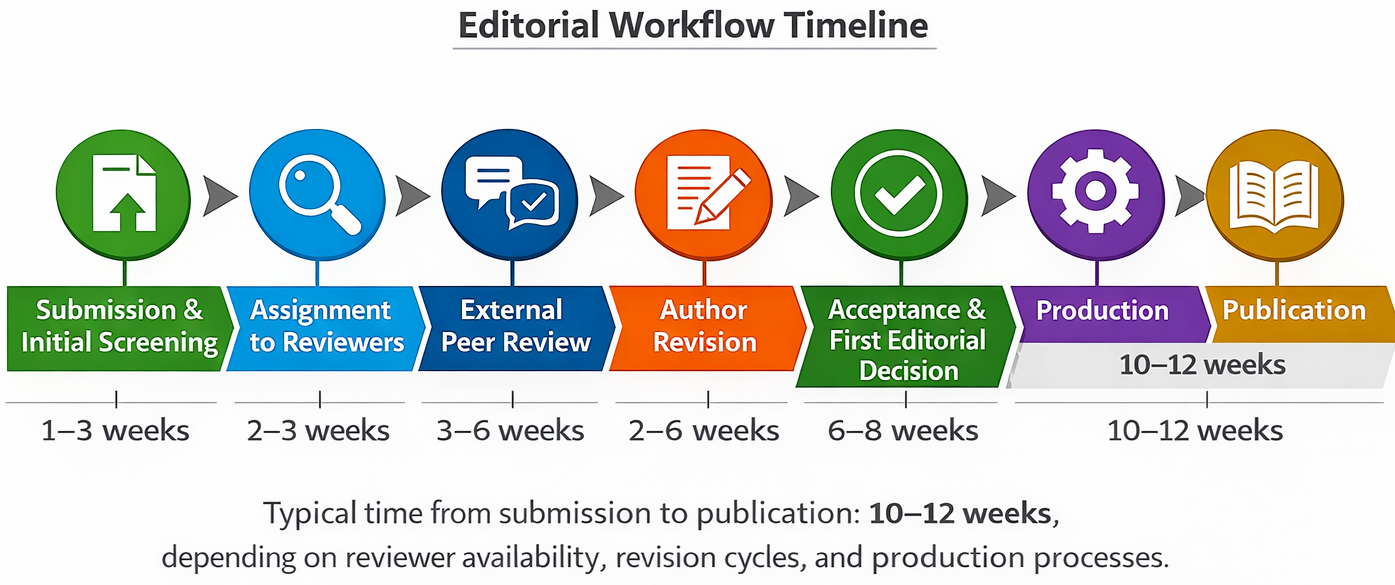
All submissions to World Nutrition undergo a multi‑stage editorial and peer review process coordinated by the Editor‑in‑Chief (EIC) and supported by Associate Editors (AEs) and Assistant Editors. The process is designed to ensure:
- Alignment with the journal’s aims and scope
- Methodological and ethical rigor
- Constructive peer review
- Clear communication with authors at every stage
Step 1: Initial Editorial Screening
Upon submission, every manuscript is first reviewed by the Editor‑in‑Chief (EIC).
At this stage, one of the following actions may be taken:
- Immediate Decline
Manuscripts may be declined without external peer review if they:
- Fall outside the scope of the journal
- Do not meet minimum scholarly or ethical standards
- Are clearly unsuitable for publication in World Nutrition
In such cases, an explanatory decision letter is sent to the corresponding author.
- Request for Clarification or Preliminary Revision
If a submission is incomplete or contains obvious errors, the EIC may request:
- Additional information
- Corrections to formatting, structure, or documentation
- Minor revisions prior to peer review
- Referral to an Associate Editor
Once a manuscript is complete and suitable for review, it is assigned to an Associate Editor (AE) with relevant subject‑matter expertise.
Step 2: Peer Review Coordination by the Associate Editor
The Associate Editor manages the double‑blind peer review process, under the oversight of the EIC.
Key elements of this stage include:
- Selection of independent external reviewers
- Monitoring review progress and timelines
- Assessing the quality and usefulness of reviews
Reviewer Scoring
Each completed review is rated on a scale of 1 to 5, reflecting its quality and thoroughness.
When:
- Two or more reviews are received with a score of at least 3, or
- An exceptionally strong review (score 5) is received alongside a weaker review (score 2),
…the reviews are forwarded to the authors.
Editorial Recommendations
At this stage, the Associate Editor may:
- Recommend revision (minor or major)
- Support reviewer recommendations for acceptance without revision
- Recommend rejection if the manuscript has fundamental flaws that cannot be resolved through revision
Step 3: Author Revision and Response
When revisions are requested, authors are required to:
- Revise the manuscript accordingly
- Submit a point‑by‑point response explaining how each reviewer comment has been addressed, or justifying why specific suggestions were not followed
Revised manuscripts are then forwarded for further editorial assessment.
Step 4: Assistant Editor Review
Revised manuscripts are reviewed by an Assistant Editor, who may:
- Conduct a detailed editorial and language review
- Make editorial edits to improve clarity and coherence
- Assess whether reviewer and editorial comments have been adequately addressed
The Assistant Editor then submits the manuscript, along with recommendations for acceptance or rejection, to the Editor‑in‑Chief.
Step 5: Editorial Decision and Further Revisions
Based on the Assistant Editor’s input, the Editor‑in‑Chief may:
- Accept the manuscript
- Reject the manuscript
- Request further revisions
In most cases, the Assistant Editor’s review—sometimes supplemented by additional editorial comments—is sent back to the authors for final adjustments.
Step 6: Final Language Editing
Once all substantive issues have been resolved, the manuscript undergoes a final language‑focused editorial edit.
If substantial editorial changes are made at this stage, the revised manuscript is returned to the authors for approval prior to acceptance.
Step 7: Acceptance and Typesetting
After final approval:
- The manuscript is formally accepted for publication
- It is sent to the professional typesetter for layout and formatting
Step 8: Author Proofing of Typeset Manuscript
The typesetter provides a draft typeset version to the corresponding author.
Authors are required to:
- Ensure that all co‑authors review the proof
- Submit any corrections or approval using the method specified by the typesetter
Only minor corrections are permitted at this stage.
Step 9: Final Approval and Publication Queue
Once the typeset proof is approved:
- The manuscript is placed in a publication queue
- It is scheduled for release in the next available fixed publication date
Commitment to Transparency and Quality
This structured workflow reflects World Nutrition’s commitment to:
- Fair and unbiased editorial decisions
- Constructive engagement with authors
- High ethical and scholarly standards
- Efficient and transparent publication practices
For questions regarding manuscript handling, authors may contact:
Email: editor@worldnutritionjournal.org
For further information on Peer Review see the page on | Peer Review Policy | Publication Ethics and Peer Review Process