Peer Review Policy
Overview
World Nutrition is committed to upholding the highest standards of scholarly quality, ethical publishing, and editorial integrity. All manuscripts submitted to the journal undergo rigorous, independent, and unbiased peer review, in line with international best practice and the principles of the Committee on Publication Ethics (COPE).
Type of Peer Review
World Nutrition operates a double-blind peer-review system for all research articles, reviews, and scholarly commentaries that involve empirical evidence.
- Authors do not know the identity of reviewers
- Reviewers do not know the identity of the authors
This process is designed to ensure fairness, minimise bias, and promote objective assessment based solely on scholarly merit, originality, and methodological rigour.
Peer Review Workflow and Timelines
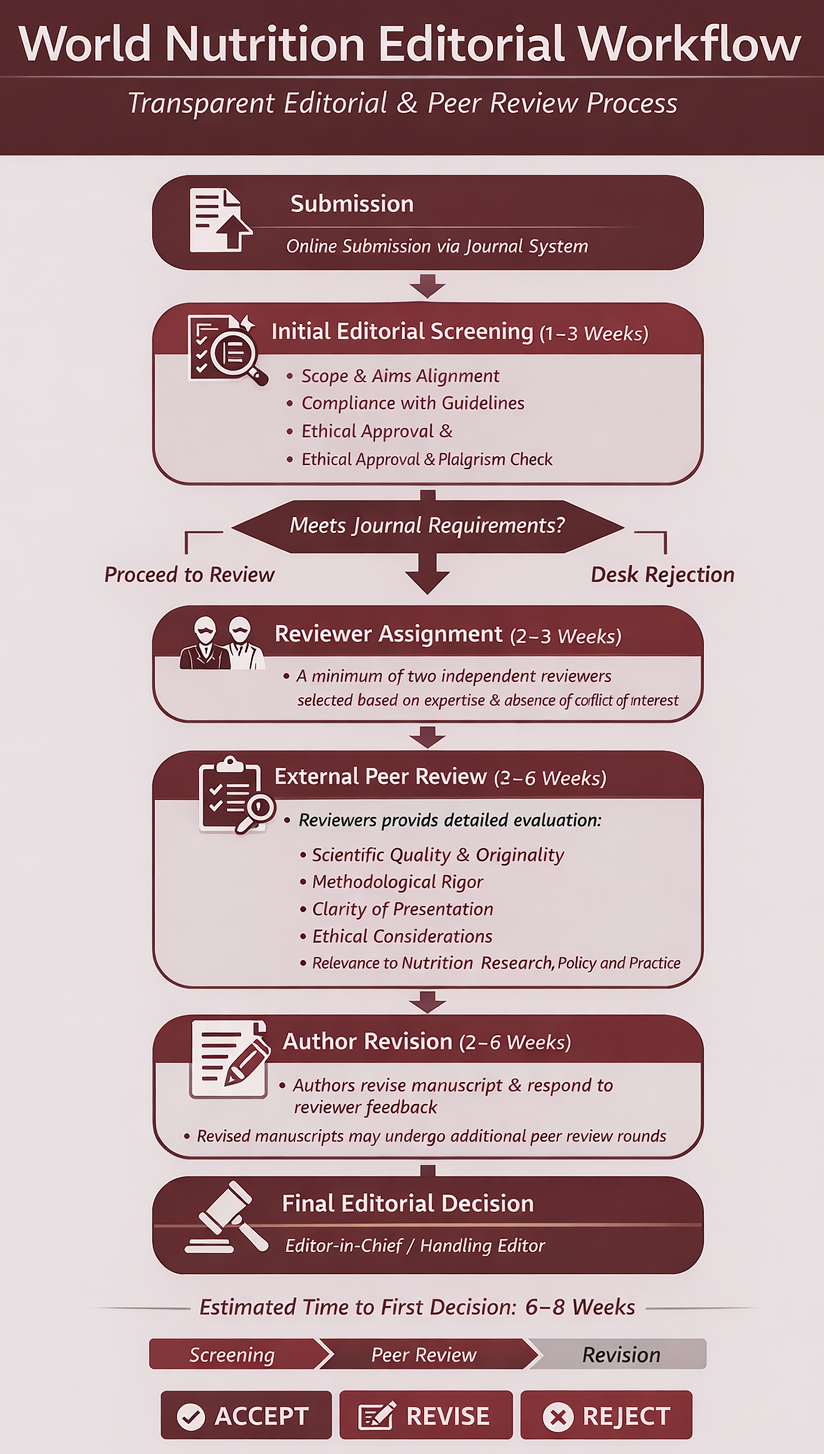
The peer review process follows a structured, transparent editorial workflow designed to ensure rigour while maintaining reasonable, predictable timelines.
- Submission and Initial Editorial Screening (1–3 weeks)
Upon submission, manuscripts undergo preliminary evaluation by the Editorial Office and handling editors to assess:
- Alignment with journal aims and scope
- Compliance with author guidelines
- Methodological soundness
- Ethical approval and reporting standards
- Plagiarism screening
Manuscripts may be declined at this stage without external review.
- Assignment to Reviewers (2–3 weeks)
Eligible manuscripts are assigned to a minimum of two independent external reviewers selected based on subject expertise, publication record, and absence of conflicts of interest.
- External Peer Review (3–6 weeks)
Reviewers are requested to provide structured and constructive assessments addressing:
- Scientific quality and originality
- Methodological rigor
- Clarity of presentation
- Ethical considerations
- Relevance to public health nutrition research, policy, and practice
- Author Revision (2–6 weeks)
Authors are invited to revise manuscripts in response to reviewer comments. Revised manuscripts may undergo additional rounds of peer review when necessary.
- Editorial Decision
Final editorial decisions are made by the Editor-in-Chief or designated Handling Editor, in consultation with Associate Editors and, where necessary, members of the Editorial Board. Decisions are based on reviewer reports, scholarly merit, originality, relevance, and ethical compliance. The first editorial decision is typically communicated within 6–8 weeks of submission.
Editorial Decision Categories
Manuscripts are assigned one of the following decisions:
- Accept
- Minor Revisions Required
- Major Revisions Required
- Reject – Resubmission Encouraged
- Reject
All decisions are accompanied by anonymised reviewer reports and editorial guidance.
The typical time from submission to publication is approximately 10–12 weeks, depending on reviewer availability, revision cycles, and production processes.
Reviewer Selection and Responsibilities
Reviewers are selected based on:
- Subject-matter expertise
- Academic or professional experience
- Relevant publication record
- Absence of conflicts of interest
- Commitment to ethical, constructive, and timely peer review
The journal actively promotes diversity among reviewers, considering geography, gender, discipline, and institutional affiliation.
Reviewers are required to:
- Treat manuscripts as confidential
- Declare conflicts of interest
- Provide objective, constructive, and evidence-based assessments
- Refrain from using artificial intelligence tools to generate peer-review reports
Conflict of Interest Management
All reviewers and editors must disclose any actual, potential, or perceived conflicts of interest before participating in editorial evaluation. Individuals with conflicts are recused from the review or decision-making process. The journal adheres to COPE guidelines for managing conflict-of-interest disclosures and ethical concerns.
Research Integrity and Ethical Oversight
World Nutrition adheres strictly to COPE principles in managing ethical issues, allegations of misconduct, data falsification, plagiarism, duplicate publication, and authorship disputes. Ethical investigations are conducted transparently, fairly, and confidentially, with appropriate corrective actions taken when necessary.
Appeals Process
Authors who believe an editorial decision was made in error may submit a formal written appeal within 14 days of receiving the decision.
Appeals should include a detailed rebuttal addressing reviewer and editorial comments and must be submitted to: editor@worldnutritionjournal.org
Appeals are reviewed independently by the Editor-in-Chief in consultation with senior editorial leadership or external experts where appropriate. Decisions following an appeal are final.
Transparency and Accountability
World Nutrition maintains full transparency in its editorial decision-making, peer-review procedures, and publication ethics. All editorial policies are publicly available, regularly reviewed, and updated in alignment with evolving best practices in scholarly publishing.