Hospital-acquired infections (HAIs) and delayed recovery from severely malnourished children during stabilization: Evidence from retrospective cohort analysis
DOI:
https://doi.org/10.26596/wn.202617377-85
Keywords:
Severe acute malnutrition (SAM),, hospital-acquired infections (HAIs),, Water, Sanitation and hygiene (WASH),, Recovery outcomes,, Antimicrobial resistanceAbstract
Background: Several studies have highlighted the high impact of HAIs and their effects on pediatric recovery in Ethiopia.
Objectives: This study examined the effect of hospital-acquired infections (HAIs) on the recovery of children with severe acute malnutrition (SAM).
Design: A retrospective cohort study was conducted at Asella Referral and Teaching Hospital in Oromia, Ethiopia.
Materials and methods: Hospital acquired infections (HAIs) defined as infections occurred within 48 hours or more after admission to the Hospital and documented by treating clinicians in medical records. Diagnosis was made using routine clinical assessment, and available laboratory findings according to the standard hospital practice. Of 635 children admitted during the study period, 142 records were excluded (not meeting SAM criteria, unacceptable age range, or incomplete data). Consequently, 493 eligible children with comprehensive documentation were included in the final study. Kaplan–Meier survival analysis was used to compare recovery times between children with and without HAIs. Time to nutritional recovery (in days), defined as the length of hospital stay until recovery, and compared between children with and without hospital-acquired infections.
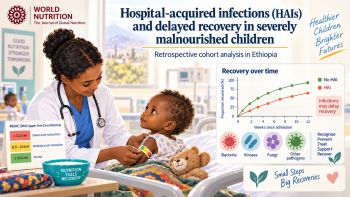
Results: Children without hospital-acquired infections had a higher probability of recovery over time compared to those with HAIs (log-rank test, p < 0.001). Factors significantly associated with HAIs included rural residence, incomplete immunization, and nasogastric tube feeding.
Conclusions: Hospital-acquired infections are a common complication among children admitted with severe acute malnutrition and are associated with slower recovery and prolonged hospital stay. Improving child survival requires an integrated approach that strengthens infection prevention and control (IPC), ensures reliable WASH infrastructure, and promotes safe feeding and hygiene practices in therapeutic feeding units. Addressing these structural and procedural gaps is essential to achieving sustainable improvements in nutrition recovery and infection control in Ethiopian hospitals.
Downloads
References
1. Allegranzi B, Nejad SB, Combescure C, Graafmans W, Attar H, Donaldson L, et al. Burden of endemic health-care-associated infection in developing countries: systematic review and meta-analysis. The Lancet. 2011;377(9761):228-41.
2. Organization WH. WHO guideline on the prevention and management of wasting and nutritional oedema (acute malnutrition) in infants and children under 5 years: World Health Organization; 2024.
3. Organization WH. Global report on infection prevention and control: World Health Organization; 2022.
4. Organization WH, Fund UNCs. The UNICEF-WHO-World Bank Joint Child Malnutrition Estimates (JME) standard methodology: tracking progress on SDG Indicators 2.2. 1 on stunting, 2.2. 2 (1) on overweight and 2.2. 2 (2) on wasting: World Health Organization; 2024.
5. Organization WH. Levels and trends in child malnutrition child malnutrition: UNICEF/WHO/World Bank Group Joint Child Malnutrition Estimates: Key findings of the 2023 edition: World Health Organization; 2023.
6. WHO. UNICEF/WHO Low Birthweight Estimates: levels and trends 2000-2020. Organization WH, editor: World Health Organization; 2023.
7. (WHO) WHO. Hospital-acquired infections: Prevention and control measures. Retrieved from [WHO website]. 2021;119:33-48.
8. Assembly UG. Transforming our world: the 2030 Agenda for Sustainable Development. 2015.
9. Unicef. Global action plan on child wasting: a framework for action to accelerate progress in preventing and managing child wasting and the achievement of the Sustainable Development Goals. 2021.
10. FMOH. Federal Ministry of Health: National Nutrition Program II (2016–2025). Federal Democratic Republic of Ethiopia, Addis Ababa.; 2016.
11. Korir J, Oldewage-Theron W, Samuel A, Gichohi-Wainaina W. Multisectoral approaches for sustainable food and nutrition security actions in Ethiopia. African Journal of Food, Agriculture, Nutrition and Development. 2024;24(5):26352-76.
12. FMOH. Federal Ministry of Health (FMOH). Ethiopian Hospital Reform Implementation Guidelines (EHRIG). Addis Ababa: Federal Democratic Republic of Ethiopia; 2019.; 2019.
13. Azanaw J, Abera E, Malede A, Endalew M. A multilevel analysis of improved drinking water sources and sanitation facilities in Ethiopia: Using 2019 Ethiopia mini demographic and health survey. Frontiers in Public Health. 2023;Volume 11 - 2023.
14. Elema TB, Negeri AA, Verstraete L, Desta AF, Al-Mulla T, Goyol K, et al. Water, sanitation, and hygiene in selected health facilities in Ethiopia: risks for healthcare acquired antimicrobial-resistant infections. Front Public Health. 2024;12:1478906.
15. Yallew WW, Kumie A, Yehuala FM. Risk factors for hospital-acquired infections in teaching hospitals of Amhara Regional State, Ethiopia: A matched case–control study. PLoS ONE, 11(8), e0160125. 2016.
16. Demissie GY, Kassie DG, Tilahun B. Prevalence and determinants of hospital-acquired infections among pediatric patients in Ethiopian referral hospitals. Infection and Drug Resistance, 13, 3459–3468. 2020.
17. Jarso H, Workicho A, Alemseged F. Survival status and predictors of mortality in severely malnourished children admitted to Jimma University Specialized Hospital from 2010 to 2012, Jimma, Ethiopia: a retrospective longitudinal study. BMC pediatrics. 2015;15(1):76.
18. Tefera T, Getachew T, Deressa A. Predictors of mortality among children treated for severe acute malnutrition in public hospitals of Southern Ethiopia. International Journal of Pediatrics, 2019, 1–9. . 2019.
19. Elema T, Negeri A, Verstraete L, Desta A, Al-Mulla T, Goyol K, et al. Water, sanitation, and hygiene in selected health facilities in Ethiopia: risks for healthcare acquired antimicrobial-resistant infections. Frontiers in Public Health. 2024;12:1478906.
20. Federal Ministry of Health (FMOH). National guideline for the management of acute malnutrition. Federal Democratic Republic of Ethiopia, Addis Ababa., (2019).
21. Togo A, Traore BA, Kante L, BT D. Fighting nosocomial infection rates in the general surgery department of the teaching hospital Gabriel Toure in Bamako, Mali. Open Biol J 2010;3:87–91. 2010.
22. Abdel-Rahman, S. M., Ridge AL, Parikh SJ. Management of severe acute malnutrition in hospitalized children: Clinical guidelines and outcomes. Journal of Tropical Pediatrics, 63(5), 367–375. . 2017.
23. Haque M, Sartelli M, McKimm J, Abu Bakar M. Health care-associated infections - an overview. Infect Drug Resist. 2018;11:2321-33.
24. Gebremichael DY, Haile D, Bayissa ZB. Treatment outcomes and associated factors among severely malnourished children in Jimma University Specialized Hospital, Southwest Ethiopia. BMC Pediatrics, 14, 232. 2014.
25. Hussen M, Assefa D, Tadesse K. Determinants of hospital-acquired infection among admitted children in Southern Ethiopia: A cross-sectional study. Ethiopian Journal of Health Sciences, 30(6), 859–868. 2020.
Downloads
Published
Data Availability Statement
The data used in this study are not publicly available due to institutional and ethical restrictions. Still, they may be made available from the corresponding author upon reasonable request and with permission from the Oromia Regional Health Bureau.
Issue
Section
License
Copyright (c) 2026 Teshome Elema, Solomon Gebretsadik , Ashenafi Habtamu, Tewodros Desalegn Nebi , Gemechu Edae, Habtamu Guja, Kaleab Baye

This work is licensed under a Creative Commons Attribution 4.0 International License.
Authors retain all copyrights. In making a submission to World Nutrition, they are certifying that all material is theirs except quotations, as indicated, and that they have obtained permission for any photos, tables, or graphics taken from other publications or websites.
How to Cite
Share