“Food as medicine”: Maximizing nutrition in antimicrobial resistance mitigation
DOI:
https://doi.org/10.26596/wn.2026172216-221
Keywords:
Nutirition, antimicrobial resistance, mitigation, antimicrobial use, malnutrition, multi-drug-resistant organisms, Sub-Saharan AfricaAbstract
Background
Antimicrobial resistance (AMR) is a growing global health threat, with sub-Saharan Africa (SSA) disproportionately affected. In 2021, SSA recorded about 923,000 AMR-associated and 209,000 AMR-attributable deaths. Key drivers include antibiotic misuse, weak water/sanitation/hygiene (WASH) systems, poor infection prevention and control (IPC), limited diagnostics, and fragile health systems. Nutrition remains an underexplored but potentially critical lever for AMR mitigation.
Objective
This perspective examines how improved nutrition could reduce AMR burden in SSA by strengthening host defenses, lowering infection risk, and decreasing unnecessary antibiotic use.
Methods
We conducted a comprehensive literature search across PubMed, Medline, Google Scholar, DOAJ, Semantic Scholar, and African Journals Online. Using MeSH and free-text terms for “nutrition”, “malnutrition”, and “antimicrobial resistance” with Boolean operators, we identified original studies and reviews linking between malnutrition and AMR in SSA.
Results
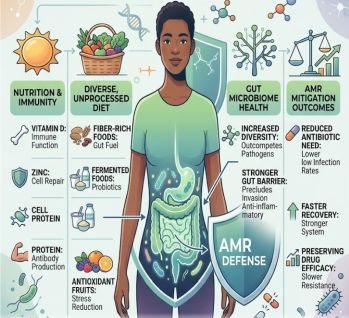
Malnutrition impairs immunity, disrupts gut barrier function, and alters the gut microbiome, increasing susceptibility to infection and colonization by multidrug-resistant organisms. Malnourished children are routinely prescribed antibiotics, further driving resistance. Conversely, diets rich in fiber, micronutrients, and fermented foods - common in traditional African diets - support a healthy microbiome, enhance colonization resistance, and reduce AMR gene carriage. Micronutrients such as zinc, iron, vitamin A, and vitamin D are vital for immune function and barrier integrity. To mitigate AMR through nutrition, promoting nutrient-dense, locally available foods and fermented products to strengthen immunity and gut health; advancing food fortification, dietary diversification, and food safety to reduce infection burden; scaling nutrition-sensitive and nutrition-specific interventions for high-risk groups, including malnourished children; and strengthening behavior change communication may proof effective.
Conclusion
Optimizing nutrition offers a practical, low-cost approach to lowering infection rates and antibiotic use in SSA. Policymakers and partners should adopt a multi-sectoral approach that embeds nutrition in AMR strategies, leverages traditional diets, and strengthens existing nutrition initiatives to reduce AMR and advance Sustainable Development Goals.
Downloads
Downloads
Published
Data Availability Statement
All relevant data are available within the manuscript
Issue
Section
License
Copyright (c) 2026 Damilare M. Akintunde, Sarah A. Y. Adam, Omotolani Olawumi Akintunde, Gloria E. Odeh, Babafunsho J. Ayinde

This work is licensed under a Creative Commons Attribution 4.0 International License.
Authors retain all copyrights. In making a submission to World Nutrition, they are certifying that all material is theirs except quotations, as indicated, and that they have obtained permission for any photos, tables, or graphics taken from other publications or websites.
How to Cite
Share