Sleep, Tryptophan Metabolism, and Breast Cancer: Implications for Public Health Nutrition
DOI:
https://doi.org/10.26596/wn.2026173155-158
Keywords:
Breast cancer, melatonin, Kynurenine pathway, Public health nutrition, sleep, Tryptophan metabolismAbstract
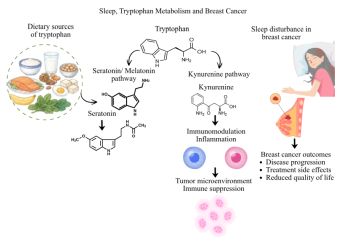
Breast cancer remains the most frequently diagnosed cancer among women worldwide and represents a major public health challenge. Sleep disturbances are highly prevalent in women with breast cancer and have been associated with impaired quality of life, circadian disruption, immune dysregulation, and adverse clinical outcomes. Tryptophan metabolism has emerged as a potential biological link between sleep regulation and breast cancer through its roles in serotonin and melatonin synthesis and the kynurenine pathway, which is implicated in tumor progression and immune modulation. This commentary discusses current evidence on the complex and context-dependent role of tryptophan metabolism, highlighting its relevance to sleep health, cancer biology, and discusses nutritional strategies from a public health perspective. While adequate dietary tryptophan may contribute to sleep regulation and well-being, excessive activation of tryptophan catabolism through the kynurenine pathway may promote an immunosuppressive tumor microenvironment. Therefore, current evidence does not support tryptophan supplementation in women with active breast cancer. Further clinical and translational studies are needed to clarify the therapeutic potential and safety of targeting tryptophan metabolism in breast cancer care.
Downloads
References
Bray, F., Laversanne, M., Sung, H., Ferlay, J., Siegel, R. L., Soerjomataram, I., & Jemal, A. (2024). Global cancer statistics 2022: GLOBOCAN estimates of incidence and mortality worldwide for 36 cancers in 185 countries. CA: A Cancer Journal for Clinicians, 74(3), 229–263. https://doi.org/10.3322/caac.21834
Cui, Z., Wang, D., Zhang, Y., Yuan, L., Zhang, Y., & Qi, X. (2025). Role of tryptophan metabolism in cancer. Cancer Innovation, 4(6), e70037. https://doi.org/10.1002/cai2.70037
Ebokaiwe, A. P., Li, L., Peng, T., Njoya, E. M., Zhou, Z., Onu, E. N., Zhang, G., & Fei, W. (2025). Anti-cancer effect of Loranthus micranthus via downregulation of inflammation, tryptophan catabolism and kynurenine synthesis. International Journal of Biochemistry & Cell Biology, 188, 106852. https://doi.org/10.1016/j.biocel.2025.106852
Giatromanolaki, A., Fiska, A., Koffa, M., & Koukourakis, M. I. (2025). Kynureninase expression is associated with immunologically hot tumors and better prognosis in IDO1/TDO2-expressing breast carcinomas. Pathology Research and Practice, 272, 156069. https://doi.org/10.1016/j.prp.2025.156069
Hill, S. M., Belancio, V. P., Dauchy, R. T., Xiang, S., Brimer, S., Mao, L., Hauch, A., Lundberg, P. W., Summers, W., Yuan, L., Frasch, T., & Blask, D. E. (2015). Melatonin: An inhibitor of breast cancer. Endocrine-Related Cancer, 22(3), R183–R204. https://doi.org/10.1530/ERC-15-0030
Li, H., Lockwood, M. B., Schlaeger, J. M., Liu, T., Danciu, O. C., & Doorenbos, A. Z. (2023). Tryptophan and kynurenine pathway metabolites and psychoneurological symptoms among breast cancer survivors. Pain Management Nursing, 24(1), 52–59. https://doi.org/10.1016/j.pmn.2022.09.002
Liu, Z. Q., Ciudad, M. T., & McGaha, T. L. (2025). New insights into tryptophan metabolism in cancer. Trends in Cancer, 11(7), 629–641. https://doi.org/10.1016/j.trecan.2025.03.008
Mei, M., Zhou, Q., Gu, W., Li, F., Yang, R., Lei, H., & Liu, C. (2025). Dietary supplement interventions and sleep quality improvement: A systematic review and meta-analysis. Nutrients, 17(24), 3952. https://doi.org/10.3390/nu17243952
Wang, W., Xiao, W., Xu, W., Ren, L., Li, X., Yu, J., & Wang, R. (2026). TDO2-associated tryptophan metabolism correlates with impaired tertiary lymphoid structure maturation and reduced B cell class switching in breast cancer. Oncology Research, 34(3), 26. https://doi.org/10.32604/or.2026.071122
Zhang, B., Tang, M., & Li, X. (2025). A narrative review of sleep and breast cancer: From epidemiology to mechanisms. Cancer Causes & Control, 36(5), 457–472. https://doi.org/10.1007/s10552-024-01951-8
Downloads
Published
Data Availability Statement
All relevant data are available within the manuscript.
Issue
Section
License
Copyright (c) 2026 Nádia Raci Marques Pereira, Isabela Antunes Ishikura, Sergio Tufik, Helena Hachul

This work is licensed under a Creative Commons Attribution 4.0 International License.
Authors retain all copyrights. In making a submission to World Nutrition, they are certifying that all material is theirs except quotations, as indicated, and that they have obtained permission for any photos, tables, or graphics taken from other publications or websites.
How to Cite
Share