Comparing front-of-pack labelling systems to improve teenagers’ food choices
DOI:
https://doi.org/10.26596/wn.2026172156-166
Keywords:
front-of-pack labelling, warning labels, adolescent food choices, NutriScore, Health Star Rating, IndiaAbstract
Background
Although the Food Safety and Standards Authority of India is currently determining regulations for foods high in fat, sugar, and salt, India has yet to establish a mandatory front-of-pack labelling (FoPL) policy. Adult consumers have dominated international FoPL research; adolescents, who make dietary decisions differently and consume more packaged snacks, remain under-represented in the evidence base.
Objective
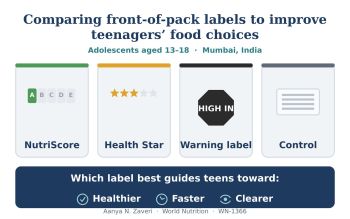
This study compared four front-of-pack labelling formats - NutriScore, Health Star Rating, Warning Labels, and a back-of-pack-only Control - to determine which most effectively promotes healthier product choices, faster decision-making, and clearer label comprehension among adolescents (aged 13-18) in Mumbai, India.
Methods
A between-subjects randomised controlled experiment was conducted in Mumbai with 120 adolescents (ages 13-18, Grades 8-12) randomly assigned to one of four conditions (n = 30 per group): Control (back-of-pack only), NutriScore, Health Star Rating (HSR), or Warning Label. Each participant selected between two mock biscuit products on a tablet screen. Primary outcomes were product choice (healthier vs. less healthy), response time (seconds), and label comprehension scores. The study was done under controlled, tablet-based conditions.
Results
Warning Labels produced the highest rate of healthier product selection (80.0%), significantly outperforming HSR (66.7%), NutriScore (56.7%), and Control (33.3%) (χ²(3) = 14.82, p = .002; Cramér’s V = .35, large effect). Warning Labels also produced the shortest median response time and highest comprehension scores. Between-group differences were significant across all six secondary outcomes (all p < .0083, Bonferroni-corrected).
Conclusion
Warning Labels consistently outperformed all other formats on every outcome measured. These results contribute preliminary experimental evidence relevant to India's FoPL policy deliberations. Larger, multi-city, real-world studies are needed before definitive policy recommendations can be made.
Downloads
References
REFERENCES
American Psychological Association. (2020). Publication manual of the American Psychological Association (7th ed.). https://doi.org/10.1037/0000165-000 DOI: https://doi.org/10.1037/0000165-000
Ben-Shachar, M. S., Lüddecke, D., & Makowski, D. (2020). effectsize: Estimation of effect size indices and standardized parameters. Journal of Open Source Software, 5(56), 2815. https://doi.org/10.21105/joss.02815 DOI: https://doi.org/10.21105/joss.02815
Cassioli, E., Rossi, E., Tenconi, E., Santonastaso, P., & Favaro, A. (2025). Nutri-Score effectiveness in improving consumers’ nutrition literacy, food choices, health, and healthy eating pattern adherence: A systematic review. Appetite, 204, 107718. https://doi.org/10.1016/j.appet.2024.107718 DOI: https://doi.org/10.1016/j.appet.2024.107718
Cohen, J. (1988). Statistical power analysis for the behavioral sciences (2nd ed.). Lawrence Erlbaum Associates.
Ducrot, P., Julia, C., & Serry, A.-J. (2022). Nutri-Score: Awareness, perception and self-reported impact on food choices among French adolescents. Nutrients, 14(15), 3119. https://doi.org/10.3390/nu14153119 DOI: https://doi.org/10.3390/nu14153119
Egnell, M., Talati, Z., Hercberg, S., Pettigrew, S., & Julia, C. (2018). Objective understanding of front-of-package nutrition labels: An international comparative experimental study across 12 countries. Nutrients, 10(10), 1542. https://doi.org/10.3390/nu10101542 DOI: https://doi.org/10.3390/nu10101542
Field, A. P. (2018). Discovering statistics using IBM SPSS statistics (5th ed.). Sage.
Food Safety and Standards Authority of India. (2022). Draft food safety and standards (labelling and display) amendment regulations. FSSAI.
Gavaravarapu, S. M., Vemula, S. R., Mendu, V. V. R., Avula, L., & Sarma, K. V. R. (2023). Acceptability and potential use of different formats of front-of-pack nutrition labels in promoting informed food choices in India: An ICMR-NIN study. Public Health Nutrition, 26(9), 1870–1882. https://doi.org/10.1017/S1368980023000484 DOI: https://doi.org/10.1017/S1368980023000484
Ghosh-Jerath, S., Kapoor, R., Singh, A., Downs, S. M., & Fanzo, J. (2024). Mapping ultra-processed foods in India: A formative research study. BMC Public Health, 24, 2508. https://doi.org/10.1186/s12889-024-19624-1 DOI: https://doi.org/10.1186/s12889-024-19624-1
Gupta, R., Bhattacharya, S., & Rathore, G. (2022). Front-of-pack labelling study: Consumer understanding and food choices (IIMA-FSSAI Report). Indian Institute of Management Ahmedabad / Food Safety and Standards Authority of India.
Health Star Rating Advisory Committee. (2019). Five-year review of the Health Star Rating system: Final report. Australian Government Department of Health.
IBM Corp. (2021). IBM SPSS Statistics for Windows, Version 28.0. IBM Corp.
Indian Council of Medical Research. (2017). National ethical guidelines for biomedical and health research involving human participants. ICMR.
Jones, A., Hoek, J., Sacks, G., & Roskam, J. (2019). The performance and potential of the Australasian Health Star Rating system: A four-year review using the RE-AIM framework. Australian and New Zealand Journal of Public Health, 43(5), 476–481. https://doi.org/10.1111/1753-6405.12908 DOI: https://doi.org/10.1111/1753-6405.12908
Kassambara, A. (2023). rstatix: Pipe-friendly framework for basic statistical tests [R package version 0.7.2]. https://CRAN.R-project.org/package=rstatix
Lancet Series on Ultra-Processed Foods in India. (2025). Burden of ultra-processed food consumption in India. The Lancet Regional Health – Southeast Asia. https://doi.org/10.1016/j.lansea.2025.100000
Mohan, V., Prabhakaran, D., & Krishnaswamy, K. (2025). Need for a strong front-of-pack labelling system in India: An expert consensus statement. Indian Journal of Medical Research, 161(2), 115–122. https://doi.org/10.4103/ijmr.ijmr_2502_24
Packer, J., Russell, S. J., Ridout, D., Hope, S., Conolly, A., Jessop, C., Robinson, O. J., Stoffel, S. T., Viner, R. M., & Croker, H. (2021). Assessing the effectiveness of front of pack labels: Findings from an online randomised-controlled experiment in a representative British sample. Nutrients, 13(3), 900. https://doi.org/10.3390/nu13030900 DOI: https://doi.org/10.3390/nu13030900
Pérez-Armijo, P., Durán-Agüero, S., Echevarría-Orella, E., Abecia-Inchaurregui, L. C., & Almendra-Pegueros, R. (2025). Front-of-pack labeling and perceived nutritional quality: Results from a quasi-experimental study in Spain. Frontiers in Nutrition, 12, 1736934. https://doi.org/10.3389/fnut.2025.1736934 DOI: https://doi.org/10.3389/fnut.2025.1736934
Pettigrew, S., Miller, C., Talati, Z., & Swinburn, B. (2020). Consumer views on the Health Star Rating nutrition labelling system in Australia. Nutrients, 12(3), 590. https://doi.org/10.3390/nu12030590
R Core Team. (2023). R: A language and environment for statistical computing (Version 4.3.1). R Foundation for Statistical Computing. https://www.R-project.org/
Ratcliff, R. (1993). Methods for dealing with reaction time outliers. Psychological Bulletin, 114(3), 510–532. https://doi.org/10.1037/0033-2909.114.3.510 DOI: https://doi.org/10.1037/0033-2909.114.3.510
Saha, S., Vemula, S. R., Mendu, V. V. R., & Gavaravarapu, S. M. (2013). Knowledge and practices of using food label information among adolescents attending schools in Kolkata, India. Journal of Nutrition Education and Behavior, 45(6), 773–779. https://doi.org/10.1016/j.jneb.2013.07.011 DOI: https://doi.org/10.1016/j.jneb.2013.07.011
Seenivasan, S., Nagpal, A., Thomas, D., & Sacks, G. (2024). Trends in the healthiness of packaged food purchases of Australian consumers before and after the introduction of voluntary Health Star Rating nutrition labels. Public Health Nutrition, 27(1), e144. https://doi.org/10.1017/S1368980024000892 DOI: https://doi.org/10.1017/S1368980024000892
Shangguan, S., Afshin, A., Shulkin, M., Ma, W., Marsden, D., Smith, J., Saheb-Kashaf, M., Shi, P., Micha, R., Imamura, F., & Mozaffarian, D. (2019). A meta-analysis of effects of food labeling on dietary choices. PLOS Medicine, 16(12), e1002799. https://doi.org/10.1371/journal.pmed.1002799 DOI: https://doi.org/10.1371/journal.pmed.1002799
Singh, S. K., Taillie, L. S., Gupta, A., Bercholz, M., Popkin, B., & Murukutla, N. (2022). Front-of-package labels on unhealthy packaged foods in India: Evidence from a randomized field experiment. Nutrients, 14(15), 3128. https://doi.org/10.3390/nu14153128 DOI: https://doi.org/10.3390/nu14153128
Taillie, L. S., Reyes, M., Colchero, M. A., Popkin, B., & Corvalán, C. (2020). An evaluation of Chile’s Law of Food Labeling and Advertising on sugar-sweetened beverage purchases from 2015 to 2017: A before-and-after study. PLOS Medicine, 17(2), e1003015. https://doi.org/10.1371/journal.pmed.1003015 DOI: https://doi.org/10.1371/journal.pmed.1003015
Talati, Z., Norman, R., Pettigrew, S., Kelly, B., Dixon, H., Ball, K., Neal, B., & Shilton, T. (2017). The impact of interpretive and reductive front-of-pack labels on food choice and willingness to pay. International Journal of Behavioral Nutrition and Physical Activity, 14, 171. https://doi.org/10.1186/s12966-017-0628-2 DOI: https://doi.org/10.1186/s12966-017-0628-2
Tomczak, M., & Tomczak, E. (2014). The need to report effect size estimates revisited: An overview of some recommended measures of effect size. Trends in Sport Sciences, 1(21), 19–25.
Vasiljevic, M., Pechey, R., & Marteau, T. M. (2018). Making food labels social: The impact of colour of nutritional labels and injunctive norms on perceptions and choice of snack foods. Appetite, 91, 56–63. DOI: https://doi.org/10.1016/j.appet.2015.03.034
Downloads
Published
Data Availability Statement
The de-identified dataset and analysis code that support the findings of this study are available from the corresponding author upon reasonable request. Raw data are stored on a password-protected, encrypted personal device and will be retained for a minimum of five years following publication. No public repository deposit has been made because participants are minors; sharing is controlled to protect participant confidentiality in line with the consent terms agreed with parents and adolescents.
Issue
Section
License
Copyright (c) 2026 Aanya N. Zaveri

This work is licensed under a Creative Commons Attribution 4.0 International License.
Authors retain all copyrights. In making a submission to World Nutrition, they are certifying that all material is theirs except quotations, as indicated, and that they have obtained permission for any photos, tables, or graphics taken from other publications or websites.
How to Cite
Share