The development of a nutritionally enhanced composite flour: nutritional, functional, and sensory properties
DOI:
https://doi.org/10.26596/wn.2026172117-123
Keywords:
Composite flour, Nutritional enhancement, Functional properties, Micronutrient deficiency, Local ingredients, Sensory evaluationAbstract
Background
The development of nutritionally enriched composite flours has gained increasing attention due to the rising prevalence of micronutrient malnutrition and diet-related health disorders. Composite flours prepared from cereals, pulses, and nutrient-rich plant ingredients can enhance the nutritional quality of staple foods while promoting the use of locally available resources.
Objective
The present study aimed to develop and evaluate a nutritionally enhanced composite flour using locally available cereals, pulses and plant-based ingredients, and to assess its functional, nutritional, and sensory characteristics.
Methods
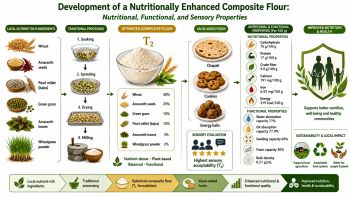
Traditional processing methods, including soaking, sprouting, drying, and milling, were used to improve nutrient bioavailability and functional properties. Three composite flour formulations were prepared using wheat, amaranth seeds, pearl millet, green gram, amaranth leaves, and wheatgrass powder in varying proportions: T₁ (40:20:10:25:4:1), T₂ (40:25:15:15:3:2), and T₃ (40:10:25:20:2:3). Value-added products such as chapati, cookies, and energy balls were developed and evaluated by a semi-trained sensory panel using a 9-point hedonic scale.
Results
Among the formulations, T₂ achieved the highest sensory acceptability across all products. Functional analysis showed water absorption capacity of 77%, oil absorption capacity of 77.9%, swelling capacity of 60%, foam capacity of 30% and bulk density of 0.21 g/mL. Nutritional analysis revealed carbohydrate content of 70 g/100 g, protein 17 g/100 g, crude fiber 5.8 g/100 g, calcium 191 mg/100 g, iron 6.55 mg/100 g and energy value of 319 kcal/100 g, indicating a nutrient-rich formulation.
Conclusions
The developed composite flour demonstrated good functional, nutritional and sensory properties, highlighting its potential as a nutritious and functional ingredient for value-added food products and as a sustainable strategy to address micronutrient deficiencies and malnutrition.
Downloads
Downloads
Published
Data Availability Statement
All data generated or analyzed during this study are included in this published article. Additional details related to the datasets used and analyzed during the current study are available from the corresponding author upon reasonable request.
Issue
Section
License
Copyright (c) 2026 Rashmi H. Poojara, Soumya P. Sreekumar, Niva Somarajan, Alvina Rose

This work is licensed under a Creative Commons Attribution 4.0 International License.
Authors retain all copyrights. In making a submission to World Nutrition, they are certifying that all material is theirs except quotations, as indicated, and that they have obtained permission for any photos, tables, or graphics taken from other publications or websites.
How to Cite
Share