Unveiling Dietary Patterns among children aged 6-23 months: A Framework Analysis for perspectives in Chinyunyu Community, Rufunsa District, Zambia
DOI:
https://doi.org/10.26596/wn.202617349-59
Keywords:
Complementary feeding, Dietary patterns, Framework analysis, Rufunsa District ZambiaAbstract
Introduction: Appropriate complementary feeding from 6–23 months is essential for child growth and development, yet dietary diversity remains inadequate in many resource-constrained settings. Understanding contextual influences on feeding practices is important for improving child nutrition.
Objective: This study examined qualitative evidence to identify dietary patterns and factors shaping complementary feeding among children aged 6–23 months in Chinyunyu, Rufunsa District, Zambia.
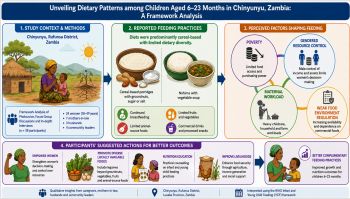
Methods: This Framework Analysis applied Gale et al. (2013) and the WHO Infant and Young Child Feeding framework to interpret qualitative data. The study was conducted in drought-prone Chinyunyu Ward, Rufunsa District, Zambia. Participants included 24 women aged 18–49 years with a child under two years and seven mothers-in-law who participated in Photovoice and focus group discussions, alongside three husbands and four community leaders who participated in in-depth interviews.
Results: Caregivers generally described awareness of recommended feeding practices; however, poverty, limited maternal decision-making power, and heavy workloads were perceived to constrain adherence. Diets cited were dominated by cereal-based porridges prepared with groundnuts, sugar, or salt. Groundnuts were reported as the main protein source, and reliance on them may have limited dietary diversity. Furthermore, increasing dependence on commercial foods was also perceived to undermine optimal complementary feeding.
Conclusions: Despite awareness of recommended feeding practices, poverty, gendered resource control, and heavy workloads were reported to constrain adherence to WHO recommendations. Empowering women, improving livelihoods, and promoting affordable dietary diversity, including legumes beyond groundnuts, may strengthen complementary feeding and child nutrition.
Downloads
References
Abate, A. D., Hassen, S. L., & Temesgen, M. M. (2023). Timely initiation of complementary feeding practices and associated factors among children aged 6–23 months in Dessie Zuria District, Northeast Ethiopia: a community-based cross-sectional study. Frontiers in Pediatrics, 11, 1062251. doi: 10.3389/fped.2023.1062251
Amugsi, D. A., Sidze, E., Thuita, F., Flax, V. L., Wilunda, C., Adair, L., Mwangi, B., Anono, E., Odhiambo, H., & Ekiru, S. (2025). Factors Influencing Wasting in Children Under 5 in Arid Regions of Kenya. Maternal & Child Nutrition, 22(1), e70036. https://doi.org/10.1111/mcn.70036
Anderson, E., Wei, R., Liu, B., Plummer, R., Kelahan, H., Tamez, M., Marrero, A., Bhupathiraju, S., & Mattei, J. (2021). Improving healthy food choices in low-income settings in the United States using behavioral economic-based adaptations to choice architecture. Frontiers in Nutrition, 8, 734991. doi: 10.3389/fnut.2021.734991.
Bergamini, M., Simeone, G., Verga, M. C., Doria, M., Cuomo, B., D’Antonio, G., Dello Iacono, I., Di Mauro, G., Leonardi, L., & Miniello, V. L. (2022). Complementary feeding caregivers’ practices and growth, risk of overweight/obesity, and other non-communicable diseases: a systematic review and meta-analysis. Nutrients, 14(13), 2646. https://doi.org/10.3390/nu14132646
Capra, M. E., Decarolis, N. M., Monopoli, D., Laudisio, S. R., Giudice, A., Stanyevic, B., Esposito, S., & Biasucci, G. (2024). Complementary feeding: tradition, innovation and pitfalls. Nutrients, 16(5), 737. https://doi.org/https://doi.org/10.3390/nu16050737
Carpenter, J. (2022). Picture this: Exploring photovoice as a method to understand lived experiences in marginal neighbourhoods. Urban Planning, 7(3), 351–362. https://doi.org/10.17645/up.v7i3.5451
Chisala, C. (2023). Optimising the Economic Weight of Thermal Springs for Rural Tourism Development in Zambia. https://doi.org/10.46222/ajhtl.19770720.415
City Population. (n.d.). Retrieved https://www.citypopulation.de/en/zambia/wards/admin/
Engidaw, M. T., Gebremariam, A. D., Tiruneh, S. A., Tesfa, D., Fentaw, Y., Kefale, B., Tiruneh, M., & Wubie, A. T. (2023). Micronutrient intake status and associated factors in children aged 6–23 months in sub-Saharan Africa. Scientific Reports, 13(1), 10179. https://doi.org/10.1038/s41598-023-36497–3.
Erasmus, C. R., Pillay, T., & Siwela, M. (2023). Factors affecting the choices made by primary caregivers during the complementary feeding transition period, KwaZulu-Natal, South Africa. South African Journal of Clinical Nutrition, 36(1), 1–7. http://creativecommons.org/licenses/by/4.0
Firdissa, S., Alemayehu, S., Workeneh, S., Nchanji, E. B., Abdulhamid, N., Tesfaye, L., Tegegne, G., Kanno, L., Ketema, D. M., & Terefe, T. (2025). Uncovering Gender Inequities: Bridging gender gaps in water access, control, and utilization among Borana Pastoralists in a changing climate. https://hdl.handle.net/10568/178485
Fragkou, P. C., Karaviti, D., Zemlin, M., & Skevaki, C. (2021). Impact of early life nutrition on children’s immune system and noncommunicable diseases through its effects on the bacterial microbiome, virome and mycobiome. Frontiers in Immunology, 12(2021), 644269. https://doi.org/10.3389/fimmu.2021.644269
Funduluka, P., Hachibamba, T., Mukuma, M., Bwembya, P., Keith, R., Kumwenda, C., & Mwila, N. M. (2023). Enhancing household soybean processing and utilization in the Eastern Province of Zambia , a concurrent triangulation study design. PLOS ONE, 1–24. https://doi.org/https://doi.org/10.1371/journal. pone.0282762
Galani, H, Y. J., Orfila, C, Gong, & Y, Y. (2022). A review of micronutrient deficiencies and analysis of maize contribution to nutrient requirements of women and children in Eastern and Southern Africa. Critical Reviews in Food Science and Nutrition, 62(6), 1568–1591. https://doi.org/10.1080/10408398.2020.1844636
Gale, N. K., Heath, G., Cameron, E., Rashid, S., & Redwood, S. (2013). Using the framework method for the analysis of qualitative data in multi-disciplinary health research. BMC Medical Research Methodology, 13(1), 117. http://www.biomedcentral.com/1471-2288/13/117
Hadley, K., Wheat, S., Rogers, H. H., Balakumar, A., Gonzales-Pacheco, D., Davis, S. S., Linstadt, H., Cushing, T., Ziska, L. H., & Piper, C. (2023). Mechanisms underlying food insecurity in the aftermath of climate-related shocks: a systematic review. The Lancet Planetary Health, 7(3), e242–e250. https://doi.org/10.1016/S2542-5196(23)00003-7
Haileselassie, M., Redae, G., Berhe, G., Henry, C. J., Nickerson, M. T., & Mulugeta, A. (2022). Educational intervention and livestock ownership successfully improved the intake of animal source foods in 6–23 months old children in rural communities of Northern Ethiopia: Quasi-experimental study. Plos One, 17(11), e0277240. https://doi.org/10.1016/S2542-5196(23)00003-7
Hamaimbo, B. T., Marinda, P. A., Nyau, V., Chileshe, J., Khayeka-Wandabwa, C., & Schoustra, S. E. (2023). Adequate dietary intake and consumption of indigenous fermented products are associated with improved nutrition status among children aged 6–23 months in Zambia. Dairy, 4(1), 137–149. https://doi.org/10.3390/dairy4010010
Kang, E., & Hwang, H.-J. (2021). Ethical conducts in qualitative research methodology: Participant observation and interview process. Journal of Research and Publication Ethics, 2(2), 5–10. doi: http://dx.doi.org/10.15722/jrpe.2.2.202109.5
Kassie, G. A., Gebrekidan, A. Y., Enaro, E. Y., & Asgedom, Y. S. (2023). Minimum acceptable dietary intake among children aged 6–23 months in Ethiopia: A systematic review and meta-analysis. PLoS One, 18(6), e0287247. https://doi.org/ 10.1371/journal.pone.02.
Kulwa, M, K. B., Mamiro, S, P., Kolsteren, & W, P. (2023). Nutrition education package focusing on infant and young child feeding in Tanzania. Journal of Nutrition Education and Behavior, 55(7), 493–508. https://doi.org/10.1016/j.jneb.2023.04.002
Kwah, K., Bartle, N., Sharps, M., Choudhry, K., Blissett, J., & Brown, K. (2025). Application of the Behaviour Change Wheel to Optimise Infant Feeding in Bangladeshi and Pakistani Communities in the UK: Co‐Development of the Learning About Infant Feeding Together (LIFT) Intervention. Maternal & Child Nutrition, 21(3), e70019. https://doi.org/10.1111/mcn.70019.
Lazarus, S., Hughes, M., Button, M., & Garba, K. H. (2025). Fraud as legitimate retribution for colonial injustice: neutralization techniques in interviews with police and online romance fraud offenders. Deviant Behavior, 47(3), 1-22. https://doi.org/10.1080/01639625.2024.244632.
Lokossou, Y. U. A., Tambe, A. B., Azandjèmè, C., & Mbhenyane, X. (2021). Socio-cultural beliefs influence feeding practices of mothers and their children in Grand Popo, Benin. Journal of Health, Population and Nutrition, 40(1), 1–12. https://doi.org/10.1186/s41043-021-00258-7
Lutter, C., K., Grummer-Strawn, L., Rogers, & L. (2021). Complementary feeding of infants and young children 6 to 23 months of age. Nutrition Reviews, 79(8), 825–846. https://doi.org/10.1093/nutrit/nuaa143
Magogodi, L. C. (2022). 11 Featured Example: Gastrotourism in Botswana, Zambia and Zimbawe. Sustainable Tourism Dialogues in Africa, 7, 191. https://books.google.co.zm/books?hl=en&lr=&id=Y_RjEAAAQBAJ&oi=fnd&pg=PA191&dq=Magogodi,+L.+C.+(2022).+11+Featured+Example:+Gastrotourism+in+Botswana,+Zambia+and+Zimbawe.+Sustainable+Tourism+Dialogues+in+Africa,+7,+191.&ots=wIiwrMMaQx&sig=Fwhm6PAq-0sZ0bPwH
Malterud, K., Siersma, V. D., & Guassora, A. D. (2016). Sample size in qualitative interview studies: guided by information power. Qualitative Health Research, 26(13), 1753–1760.
Martin, S. L., Matare, C. R., Kayanda, R. A., Owoputi, I., Kazoba, A., Bezner Kerr, R., Nnally, L., Khan, M., Locklear, K. H., & Dearden, K. A. (2021). Engaging fathers to improve complementary feeding is acceptable and feasible in the Lake Zone, Tanzania. Maternal & Child Nutrition, 17, e13144. https://doi.org/10.1111/mcn.13144Digital O.
Masuke, R., Msuya, S. E., Mahande, J. M., Diarz, E. J., Stray-Pedersen, B., Jahanpour, O., & Mgongo, M. (2021). Effect of inappropriate complementary feeding practices on the nutritional status of children aged 6-24 months in urban Moshi, Northern Tanzania: Cohort study. PLoS ONE, 16(5 May), 1–16. https://doi.org/10.1371/journal.pone.0250562
Moramarco, S., Roster Mwaba, I., Chafula Muyaba, L., Palombi, L., & Buonomo, E. (2023). Improvement in dietary diversity and feeding habits of malnourished under-five children attending supplementary feeding programmmes: a community-based cross-sectional study in Zambia. International Journal of Food Sciences and Nutrition, 74(1), 82–94. https://doi.org/https://doi.org/10.1080/09637486.2022.2144148
Moreira, P. R., Silveira, M. B., Neves, R. O., Nunes, L. M., & Bernardi, J. R. (2024). Estimated energy and nutrient intake in complementary feeding methods in Brazilian infants: randomized clinical trial. Scientific Reports, 14(1), 13. https://doi.org/10.1038/s41598-023-50415-7
Moreno, J. M., Chapman, A. J., Ebido, C. C., Sougou, N. M., Diallo, A. H., Tening, R. N., Dial, F. B., Massonnié, J., Firoozmand, M., & Niang, C. E. H. A. (2023). Local contextual factors of child stunting found via shared values of stakeholder groups: an exploratory case study in Kaffrine, Senegal. Public Health Nutrition, 26(11), 2418–2432. https://doi.org/10.1017/S1368980023001088
Mukanu, M. M. (2022). Development of evidence-based context appropriate public policy reform models that coherently promote healthy food environments and food consumption patterns in Zambia. https://uwcscholar.uwc.ac.za:8443/server/api/core/bitstreams/e4e8f52e-eb05-4fa9-bdba-6251255588c1/content
Ngoma, H., Finn, A., & Kabisa, M. (2024). Climate shocks, vulnerability, resilience and livelihoods in rural Zambia. Climate and Development, 16(6), 490-501. DOI: 10.1080/17565529.2023.2246031.
Oladiran, D. A., & Emmambux, N. M. (2022). Locally available african complementary foods: nutritional limitations and processing technologies to improve nutritional quality—a review. Food Reviews International, 38(5), 1033-1063. https://doi.org/10.1080/87559129.2020.1.
Osborne, N., & Grant-Smith, D. (2021). In-depth interviewing. In Methods in urban analysis (pp. 105–125). Springer. doi:10.1007/978-981-16-1677-8_7
Padhani, Z. A., Das, J. K., Siddiqui, F. A., Salam, R. A., Lassi, Z. S., Khan, D. S. A., Abbasi, A. M. A., Keats, E. C., Soofi, S., & Black, R. E. (2023). Optimal timing of introduction of complementary feeding: a systematic review and meta-analysis. Nutrition Reviews, 81(12), 1501–1524. https://doi.org/10.1093/nutrit/nuad019
Palinkas, L. A., Horwitz, S. M., Green, C. A., Wisdom, J. P., Duan, N., & Hoagwood, K. (2015). Purposeful sampling for qualitative data collection and analysis in mixed method implementation research. Administration and Policy in Mental Health and Mental Health Services Research, 42(5), 533–544.
Rahayuwati, L., Komariah, M., Sari, C. W. M., Yani, D. I., Hermayanti, Y., Setiawan, A., Hastuti, H., Maulana, S., & Kohar, K. (2023). The influence of mother’s employment, family income, and expenditure on stunting among children under five: a cross-sectional study in Indonesia. Journal of Multidisciplinary Healthcare, 2271-2278. https://doi.org/10.2147/JMDH.S417749. https://doi.org/10.2147/JMDH.S417749
Rietveld, A., Farnworth, C. R., Shijagurumayum, M., Meentzen, A., Voss, R. C., Morahan, R., & López, D. E. (2023). An evidence synthesis of gender norms in agrifood systems: Pathways towards improved women’s economic resilience to climate change. https://cgspace.cgiar.org/server/api/core/bitstreams/128279e2-3342-48a7-86c5-2845ee606558/content
Sarwar, A., Jadoon, A. K., Chaudhry, M. A., Latif, A., & Javaid, M. F. (2024). How important is parental education for child nutrition: analyzing the relative significance of mothers’ and fathers’ education. International Journal of Social Economics, 51(10), 1209–1225. DOI 10.1108/IJSE-06-2023-0483
Travasso, S. M., Thomas, T., Makkar, S., John, A. T., Webb, P., & Swaminathan, S. (2023). Contextual factors influencing production, distribution, and consumption of nutrient-rich foods in Bihar, India: a qualitative study of constraints and facilitators. Food and Nutrition Bulletin, 44(2), 100-115. DOI: 10.1177/03795721231172251. doi: 10.1177/03795721231172251
Tura, D. C., Belachew, T., Tamiru, D., & Abate, K. H. (2025). Nutritional enrichment of traditional complementary foods using underutilized nutritious plant foods in sub-Saharan Africa: their nutritional potential and health benefits: A scoping review. Applied Food Research, 5(1), 100726. https://doi.org/10.1016/j.afres.2025.100726
Urugo, M. M., Teka, T. A., Lema, T. B., Lusweti, J. N., Djedjibegovíc, J., Lachat, C., Tesfamariam, K., Mesfin, A., Astatkie, T., & Abdel-Wahhab, M. A. (2024). Dietary aflatoxins exposure, environmental enteropathy, and their relation with childhood stunting. International Journal of Food Sciences and Nutrition, 75(3), 241-254. https://doi.org/10.1080/09637486.2024.231.
Vyas, S. (2021). A systematic review on nutritional vulnerability and opportunity during the first 1000 days of life for ensuring better human capital. Indian Journal of Science and Technology, 14(30), 2511–2516. doi: 10.17485/IJST/v14i30.1253
WHO, & UNICEF. (2021). Indicators for assessing infant and young child feeding practices: definitions and measurement methods. https://www.who.int/publications/i/item/9789240018389
Yakubu, N. (2023). Assessment of the Impact of Caregivers Complementary Feeding Knowledge on Undernutrition among Children 6 to 36 Months in Borno State, Nigeria. Assessment, 11(3). doi:10.1177/1525822X05282260.
Zerfu, T., Duncan, A., Baltenweck, I., & McNeill, G. (2025). Low awareness and affordability are major drivers of low consumption of animal‐source foods among children in Northern Ethiopia: A mixed‐methods study. Maternal & Child Nutrition, 21(1), e13720. https://doi.org/10.1111/mcn.13720
ZSA. (2024). Zambia Demographic and Health Survey Key Indicators Report. The DHS Program ICF Rockville, Maryland, USA. https://www.bing.com/search?q=zdhs+2024+pdf&qs=AS&pq=zdhs&sk=UT1MT1&sc=12-4&cvid=C797195C9A7042F7B03A65B6B4DA1F94&FORM=QBRE&sp=3&ghc=1&lq=0
Downloads
Published
Data Availability Statement
Nil
Issue
Section
License
Copyright (c) 2026 Priscilla Funduluka, Mercy Mukuma, Regina Keith, Phoebe Bwembya, Natasha Muchemwa Mwila, Twambo Hachibamba, Chiza Kumwenda

This work is licensed under a Creative Commons Attribution 4.0 International License.
Authors retain all copyrights. In making a submission to World Nutrition, they are certifying that all material is theirs except quotations, as indicated, and that they have obtained permission for any photos, tables, or graphics taken from other publications or websites.
How to Cite
Share