Impact of stress on eating behaviours in young adults
DOI:
https://doi.org/10.26596/wn.202617218-23
Keywords:
eating habits, stress, food frequency, dietary behaviour, PSS-10Abstract
Background
Stress is the body’s non-specific response to psychological and physical stimuli, which can disrupt eating habits. Stressors such as educational, social or psychological pressure significantly alter eating patterns, including Western and snack-heavy dietary patterns. Understanding the intricate relationship between stress and eating behaviours in young adults is crucial.
Objective
This study aimed to investigate the impact of stress on eating behaviour. The study focused on Sustainable Development Goal 3 (SDG-3), which emphasises health and well-being.
Methods
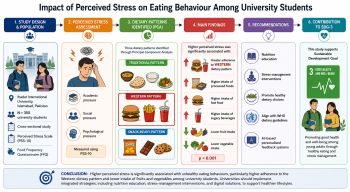
A cross-sectional study was conducted at Ibadat International University, Islamabad, Pakistan. The study investigated the association between perceived stress and eating behaviours among university students (N=350) using the PSS-10 and a validated food frequency questionnaire (FFQ).
Results
Principal Component Analysis identified three dietary patterns: 'Traditional,' 'Western,' and 'Snack-heavy.' Students with high stress showed significantly higher adherence to the 'Western' pattern (high in processed foods, sugary beverages, and fast food) and lower fruit/vegetable intake (p<0.001).
Conclusion
These findings underscore the need for nutrition education and stress-coping interventions in universities to support healthier dietary choices aligned with the WHO dietary guidelines. Digital platforms and AI-based personalised feedback systems could be developed to support stress management and promote healthy eating among students.
Downloads
Downloads
Published
Data Availability Statement
The data supporting the findings of this study are available from the corresponding author upon reasonable request.
Issue
Section
License
Copyright (c) 2026 Saliha Shaheen, Amna Shafiq, Eman Maqsood, Anila Kanwal, Madiha Iftikhar, Maimoona Waheed

This work is licensed under a Creative Commons Attribution 4.0 International License.
Authors retain all copyrights. In making a submission to World Nutrition, they are certifying that all material is theirs except quotations, as indicated, and that they have obtained permission for any photos, tables, or graphics taken from other publications or websites.
How to Cite
Share