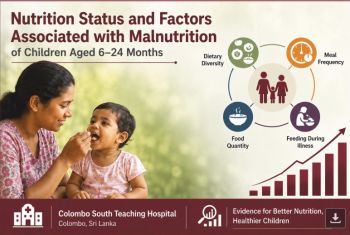
Undernutrition and its contributing factors among children aged 6–24 months attending a tertiary care hospital: A cross-sectional descriptive study
DOI:
https://doi.org/10.26596/wn.2026172132-138
Keywords:
undernutrition, complementary feeding, socioeconomic disparities, feeding during illnessAbstract
Background
Undernutrition continues to be a major concern among Sri Lankan children under the age of 2 years, despite the country’s good maternal and child health indicators. The first 1000 days of life are crucial for proper growth and neurological development, and failing to meet nutritional demands during this time can lead to long-term consequences. While the economic crisis has worsened household food insecurity, there is very limited information on how this has affected complementary feeding (CF), particularly during childhood illness, when specific nutritional interventions may be able to reverse their growth faltering.
Objective
This study assessed the prevalence of undernutrition and the factors contributing to it among infants and young children attending a tertiary care centre.
Methods
A cross-sectional descriptive study was conducted at Colombo South Teaching Hospital (CSTH) involving 246 children aged 6–24 months. Anthropometric measurements were used to evaluate nutritional status, while CF practices and socio-demographic variables were assessed via an interviewer-administered questionnaire. Descriptive statistics and chi-square testing were used for data analysis.
Results
Among those studied, 14.6% were underweight, 18.3% were stunted, and 24.8% had wasting. Both stunting and wasting were significantly associated with poor maternal education (p<0.05) and lower household income (p<0.01). Inadequate CF, particularly low quantity, was a major contributor, increasing the odds of underweight (Odds Ratio/OR=3.2), stunting (OR=4.5), and wasting (OR=2.1). Although meal frequency and food consistency were mostly appropriate, the diversity guidelines were met in only 76.8% of cases. Offering extra meals was seen in 78% during illness, but few provided energy-dense (21%) or favourite foods (43%).
Conclusion
While frequency was generally adequate among 6–24-month-old children attending the paediatric clinic or ward at CSTH, shortcomings remained in the quantity of food, dietary diversity, and feeding during illness. Interventions, particularly maternal education for low-income families, are important for improving nutrition in this age group.
Downloads
Downloads
Published
Data Availability Statement
The data supporting the findings of this study are presented within the article. The underlying dataset is not publicly available because of ethical and confidentiality restrictions relating to the protection of participant information.
Issue
Section
License
Copyright (c) 2026 Maldeniyage B.N. Mannapperuma, Shanthini Ganesan

This work is licensed under a Creative Commons Attribution 4.0 International License.
Authors retain all copyrights. In making a submission to World Nutrition, they are certifying that all material is theirs except quotations, as indicated, and that they have obtained permission for any photos, tables, or graphics taken from other publications or websites.
How to Cite
Share